Wednesday, September 28, 2011

Chapter 10: Amos Owen, the Dakota Holy Man

Calumet from the Peabody Museum at Harvard University.
 Because of Amos Owen, a bit of Native American culture survives in the shadow of a nuclear power plant. Sometimes, the sound of drums, singing and chanting in Dakota Sioux language can be heard as people worship in the sweat lodge in his backyard.
There is no written Bible in the Native American religion and no ordained ministers. People find the spiritual leaders though, and Owen gets visitors from all over the world. Many visit and participate in a worship service in his sweat lodge.
When Jacques Cousteau traveled the Mississippi River, he stopped to visit Owen. So did I. Read the story by clicking here.

Thursday, August 25, 2011

Chapter 9: Tornado Near Prescott, Wisconsin

The Upper Mississippi south of St. Paul, MN.
Prescott, Wisconsin. – The beauty of the morning seemed to be an apology for the storm the night before. The sun rose on a clear, blue sky and the cool air felt light and fresh. The gentle breeze carried a clean “just-rained” odor and brought the smell of wet leaves and flowers up to the bank.  The river ran high and muddy, with leaves, green branches and one tree that had been uprooted somewhere upstream.
Yesterday’s journal entry brought a smile. Standing in the shade, and leafing through the pages to look for water damage, I noted the entry for July 15 would have to be re-written after the tornado of the night before.
All I’d mentioned was: “…..a routine, HOT day from Hastings, Minn. to -”
To read the chapter, click Prescott tornado!

Tuesday, August 2, 2011

Chapter 8: Little Falls to St. Paul

St. Anthony Falls was the first lock and dam I saw on the river.
After five weeks on the upper Mississippi, Mike and I got to St. Paul, Minnesota.
Mike's river trip was over, and he headed back home to Iowa.
I re-fitted the canoe with oars and kept heading  south!
To read this chapter, click here!

Monday, July 11, 2011

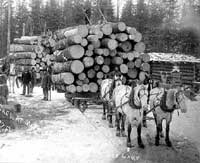
Chapter 7: Bill Byers the Logger and the Great Minnesota Timber Rush

Logging camp scene.
Northern Minnesota was the right place, at the right time, for a logging boom. Accessible timber was very valuable after the Civil War. The treeless prairies were being settled by farmers and they weren’t happy with sod buildings for long. They wanted boards for building houses, barns, fences, chicken coops and other farm buildings, and nearby Minnesota was full of trees.
According to frontier logic, the forests were inexhaustible. So, from about 1870 well into the 1930s, the great timber rush lasted. It marked one of the bigger land grabs -and wastes – in American history.
I got the chance to interview Bill Byers, one of the last loggers alive from that logging era prior to World War II. Here is his story.

Chapter 6: Cass Lake and the Ricers

This 1905 postcard shows traditional wild rice harvesting.
“It was here that we saw the Indians, even at this early period of the year, gathering their wild rice harvest. Several canoes were at work (men and women) in a flooded marsh. The men cut off the green heads of the river plant and let them fall into the canoe, while women stowed them away. Great was the merriment.” (- John J. Bigsby, early 1800s, near the Canadian border with the boundary commission.) 

Mike and I thought the rice beds were a nuisance - they were hard to paddle through and forced us to make detours out into the middle of  Cass Lake.

To the Indians, the rice beds were a source of wealth. The Chippewa Indians living on the Leech Lake Indian Reservation think the beds are a gift from God. Wars have been fought and treaties signed to guarantee the right to harvest the wild rice. Today, wild rice is still important to the Indian people.
To read the rest of the chapter, click on wild ricers.

Wednesday, July 6, 2011

Chapter 5: Lake Winnibigoshish

Sunset on Lake Winnie
Lake Winnibigoshish – also known as Lake Winnie – is the fifth largest lake in Minnesota and covers 67,000 acres. 
It is well known as one of the finest walleye fishing lakes in Minnesota. The Mississippi River flows through Winnie’s center. Its widest spot – 11 miles -  is also the Mississippi’s widest spot.
It is also the site of some of the worst traveling conditions Mike and I came across.
To read the chapter, click on Lake Winnibigoshish.

Monday, June 27, 2011

Chapter 4: Lobo Minnesota

Lobo Minnesota was as big as the man who caught him!
Lobo Minnesota: Long before wolves were re-introduced back into Yellowstone National Park, the wolf topic was controversial. In the 1930s, a giant Canadian wolf became infamous for slaughtering deer in the Lake Itasca area. Here is the story of the man who ended the wolf’s bloody career.
Click on Lobo Minnesota to read the story!