Tuesday, April 3, 2012

Chapter 12: Clammers on the Upper Mississippi

This shell from the Mississippi  produced many buttons.
Clamming is one of those river occupations that has changed with the times. Once a thriving business, today clamming is a niche industry practiced by a few on the upper Mississippi.
The SCUBA divers looked like they should be out on the ocean, not in the river channel, somewhere south
of Prairie du Chein, Wisconsin. They had all the equipment of deep sea divers, including black rubber wet suits, masks and weight belts. They would have looked good in a Jacques Cousteau film, except for the tennis shoes and knee pads.
Whatever they were doing, they looked interesting. As Dunderhead pulled nearer to their boat, I called out:
“Howdy! Are you guys salvage divers? What are you doing with all the diving gear?”
A thick-set, black-clad figure with thick sideburns hollered back.
“We’re diving for clams,” he replied. “We pick them up off the bottom, put them in this barrel and when we get a load, we sell them to a dealer in Prairie du Chien. (Click on Mississippi River Clammers to read the rest of the story.)

Thursday, October 6, 2011

Chapter 11: Vision Quest?

Omaha Indian encampment, sometime in late 1800s. (Omaha Public Library photo)
Funny how things work out. Sometimes an experience will bring up memories that have lain dormant for years. Maybe it was of something that didn’t seem particularly important at the time it was happening. Possibly the new experience is like a key word on a computer that opens up an apparently unrelated, or unsuspected file.
Or maybe that first memory wasn’t complete, without something to trigger it.
Beats me. That night, on a Mississippi River sandbar I sat next to a dying campfire. My thoughts were about  another campfire on the Omaha Indian Reservation, three years before.
(For this story to be in context, read: Amos Owen, Dakota Holy Man first!)

To read the complete Downriver: Chapter 11, click here.

Wednesday, September 28, 2011

Chapter 10: Amos Owen, the Dakota Holy Man

Calumet from the Peabody Museum at Harvard University.
 Because of Amos Owen, a bit of Native American culture survives in the shadow of a nuclear power plant. Sometimes, the sound of drums, singing and chanting in Dakota Sioux language can be heard as people worship in the sweat lodge in his backyard.
There is no written Bible in the Native American religion and no ordained ministers. People find the spiritual leaders though, and Owen gets visitors from all over the world. Many visit and participate in a worship service in his sweat lodge.
When Jacques Cousteau traveled the Mississippi River, he stopped to visit Owen. So did I. Read the story by clicking here.

Thursday, August 25, 2011

Chapter 9: Tornado Near Prescott, Wisconsin

The Upper Mississippi south of St. Paul, MN.
Prescott, Wisconsin. – The beauty of the morning seemed to be an apology for the storm the night before. The sun rose on a clear, blue sky and the cool air felt light and fresh. The gentle breeze carried a clean “just-rained” odor and brought the smell of wet leaves and flowers up to the bank.  The river ran high and muddy, with leaves, green branches and one tree that had been uprooted somewhere upstream.
Yesterday’s journal entry brought a smile. Standing in the shade, and leafing through the pages to look for water damage, I noted the entry for July 15 would have to be re-written after the tornado of the night before.
All I’d mentioned was: “…..a routine, HOT day from Hastings, Minn. to -”
To read the chapter, click Prescott tornado!

Tuesday, August 2, 2011

Chapter 8: Little Falls to St. Paul

St. Anthony Falls was the first lock and dam I saw on the river.
After five weeks on the upper Mississippi, Mike and I got to St. Paul, Minnesota.
Mike's river trip was over, and he headed back home to Iowa.
I re-fitted the canoe with oars and kept heading  south!
To read this chapter, click here!

Monday, July 11, 2011

Chapter 7: Bill Byers the Logger and the Great Minnesota Timber Rush

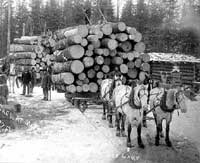
Logging camp scene.
Northern Minnesota was the right place, at the right time, for a logging boom. Accessible timber was very valuable after the Civil War. The treeless prairies were being settled by farmers and they weren’t happy with sod buildings for long. They wanted boards for building houses, barns, fences, chicken coops and other farm buildings, and nearby Minnesota was full of trees.
According to frontier logic, the forests were inexhaustible. So, from about 1870 well into the 1930s, the great timber rush lasted. It marked one of the bigger land grabs -and wastes – in American history.
I got the chance to interview Bill Byers, one of the last loggers alive from that logging era prior to World War II. Here is his story.

Chapter 6: Cass Lake and the Ricers

This 1905 postcard shows traditional wild rice harvesting.
“It was here that we saw the Indians, even at this early period of the year, gathering their wild rice harvest. Several canoes were at work (men and women) in a flooded marsh. The men cut off the green heads of the river plant and let them fall into the canoe, while women stowed them away. Great was the merriment.” (- John J. Bigsby, early 1800s, near the Canadian border with the boundary commission.) 

Mike and I thought the rice beds were a nuisance - they were hard to paddle through and forced us to make detours out into the middle of  Cass Lake.

To the Indians, the rice beds were a source of wealth. The Chippewa Indians living on the Leech Lake Indian Reservation think the beds are a gift from God. Wars have been fought and treaties signed to guarantee the right to harvest the wild rice. Today, wild rice is still important to the Indian people.
To read the rest of the chapter, click on wild ricers.

Wednesday, July 6, 2011

Chapter 5: Lake Winnibigoshish

Sunset on Lake Winnie
Lake Winnibigoshish – also known as Lake Winnie – is the fifth largest lake in Minnesota and covers 67,000 acres. 
It is well known as one of the finest walleye fishing lakes in Minnesota. The Mississippi River flows through Winnie’s center. Its widest spot – 11 miles -  is also the Mississippi’s widest spot.
It is also the site of some of the worst traveling conditions Mike and I came across.
To read the chapter, click on Lake Winnibigoshish.

Monday, June 27, 2011

Chapter 4: Lobo Minnesota

Lobo Minnesota was as big as the man who caught him!
Lobo Minnesota: Long before wolves were re-introduced back into Yellowstone National Park, the wolf topic was controversial. In the 1930s, a giant Canadian wolf became infamous for slaughtering deer in the Lake Itasca area. Here is the story of the man who ended the wolf’s bloody career.
Click on Lobo Minnesota to read the story!

Friday, June 17, 2011

Chapter 3: Lake Itasca to Bemidji

The Upper Mississippi is incredible!
We started paddling the next morning from Wanagan campground through a canoeist’s paradise.
The scenery ranged from pine forests that infused the air with a sweet, pine woods smell, to marshes full of cattails with stalks higher than our heads. The wetlands were full of waterfowl.  It seemed at every bend there was a mother duck thrashing on the water surface and acting crippled to lure us away from her nest.
Walleyes, northern pike and sauger swim in the northern stretches of the river. Crappies, plump bluegills, largemouth bass and bullheads are in the backwater lakes and sloughs. Channel catfish are found virtually everywhere, and the white bass fisheries can explode at times. 
To read the rest of this chapter, click on Itasca to Bemidji.

Saturday, June 11, 2011

Chapter 2: Preparation and Heading out

The mighty Mississippi doesn't look like much initially!
Among the questions people always asked were some about my background. Many assumed I was a professional adventurer of some sort, and that canoeing the Mississippi was just one in a series of  expeditions.

Actually, I am so ordinary as to be boring. Here is a little about me, how the trip got started, and the story of the first day on the river.
To read chapter 2, click where the Mississippi River canoe trip all started.

Wednesday, June 8, 2011

Introduction and Chapter 1

Headwaters of the Mississippi at Lake Itasca, MN.
There is just something about the Mississippi River. The broad, muddy river that crosses America just has “it.” And I’m not really sure what “it” is. But the Old Man has some sort of irresistible pull and attraction to people like me, and there is no telling where that comes from.
Modern end-to-end travelers are part of the Mississippi River folklore. Every year, a handful of adventurers/voyagers/nut cases set out on the voyage.
On June 7, 1980, I set my canoe in at the Mississippi River headwaters, and pointed it downriver. I wondered where that stream would take me...
Here is the first installment in that story! Click here to read it!

Sunday, May 8, 2011

Mississippi River Floods: We've Been Warned!

One cannot tame that lawless stream, cannot curb it or confine it, cannot say to it: 'Go There' and make it obey...cannot bar its path with an obstruction which it will not tear down, dance over and laugh at." - Mark Twain

Friday, May 6, 2011

A Mississippi River Canoe Adventure?

There is just something about the Mississippi River. The broad, muddy river that crosses America just has "it." And I'm not really sure what "it" is. But the Old Man has some sort of irresistible pull and attraction to some people like me, and there is no telling where that comes from.
I was a river rat long before ever actually seeing the Mississippi. My fascination with that whole river lifestyle started when Mark Twain crossed my path.
In the sixth grade, I was already a hopeless book nerd, and even then, my idea of a good time was reading a new book Then, I met "Huckleberry Finn." And in common with most kids who hung out with him, Huck got me in trouble!
 "Leon!"
The voice made me jump in my seat. I had snuck in from the playground at recess to read, because Huck and Jim were nearing Cairo, Illinois, and I just had to see what would happen. The baseball game was boring, and besides, what was Huck going to do? He wouldn't really turn Jim in to the slave catchers, would he? I was so engrossed in Huck's dilemma I didn't hear anyone walk up behind me.
But my teacher, Mrs. Platte, had apparently noticed my absence. Now, she stood frowning in the door, arms crossed.
"You're not supposed to be in here!" she said, giving me that withering look that could put the most boisterous sixth-grader in his place. "What do you think you're doing?"
"Just reading," I said, giving her my innocent look, and lifted up the book to show the cover.
Her expression changed, and the thundercloud dissipated some. She still made an attempt to continue glaring at me.
"I had to see how it came out," I said. Maybe I should ask a question, I thought - that generally made Mrs. Platte happy. It wouldn't hurt to try, since it looked like I was about to catch hell anyway!
"Have you ever seen the Mississippi? Is the river like it says in this book?"
Mrs. Platte struggled with her poker face.
"Leon: You are making a poor attempt to divert my attention," she said. "Yes, I have seen the Mississippi, and not even Mark Twain could do justice to it. It is magnificent beyond belief."
"Wow...A mile wide..."
"Now explain this, please," she interrupted.
"Most of my boys would rather play baseball than eat. But you leave the game, to come inside and read a book that isn't even required reading until the eighth grade!"she said.
"So, just what am I supposed to do with you?"
I tried to look even smaller and more pathetic, and slipped down a little more in my chair.
"Well, I guess you don't have much choice," I said slowly and sadly. "You're going to have to keep me in from recess and make me read a book."
At that, any attempt at composure left Mrs. Platte, and she threw back her head and laughed out loud.
"OUT!" she yelled, and pointed to the door. "And you better beat me back to that diamond!"
I ran past and outside, and then slowed down. I wasn't real worried about her catching me, not when she was laughing that hard.
But I was going to see that big river some day, I promised myself, while headed back to the playground.
I knew that.